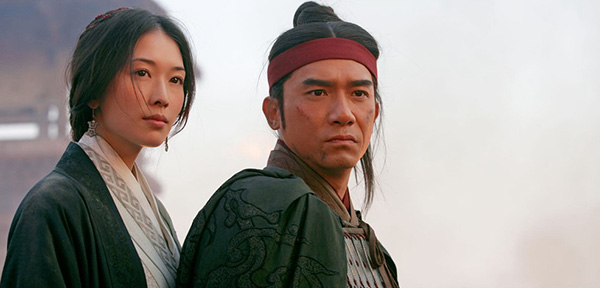
Red Cliff (Film)
Overview
Red Cliff is a film directed by the acclaimed Chinese director John Woo, inspired by the legendary Battle of Red Cliffs during the Three Kingdoms period in ancient China. It dramatizes the events of the pivotal battle in 208 AD, where the allied forces of the kingdoms of Shu and Wu, led by the Liu Bei and Sun Quan and under the strategist Zhuge Liang and Zhou Yu, opposed the numerically superior forces of the warlord Cao Cao from the Kingdom of Wei.
Historical Context
The Battle of Red Cliffs is one of the most famous military confrontations in East Asian history. It took place at a critical juncture during the late Han Dynasty, as various factions battled for supremacy over China. The defeat of Cao Cao at Red Cliffs halted his expansion into southern China and set the stage for the establishment of the Three Kingdoms of Wei, Shu, and Wu. This battle has been immortalized through folklore, literature, including Luo Guanzhong's 14th-century historical novel Romance of the Three Kingdoms, and various adaptations in modern media.
Film Production
John Woo's Red Cliff was a major cinematic undertaking, noted for its grand scale and meticulous historical detail. The film was released as two separate installments in Asia but was condensed into a single film for some international markets. The production involved elaborate set designs, costumes replicating the era's attire, and extensive use of battle choreography to authentically depict the strategic genius and military tactics employed during the battle.
Cast
The film features an ensemble cast, including Tony Leung as Zhou Yu, Takeshi Kaneshiro as Zhuge Liang, and Zhang Fengyi as Cao Cao, bringing to life the iconic figures of this historical saga.
Cultural Significance
The film Red Cliff is not only a historical epic but also a cultural touchstone that brings to life the rich tapestry of Chinese history and mythology.
The battle has been depicted in various art forms, such as Peking Opera, showcasing the enduring influence of the event on Chinese culture. Beyond film and opera, the Battle of Red Cliffs has inspired numerous artworks, literature, and even strategic studies, serving as a case study in military tactics.
The movie also highlights the themes of loyalty, strategy, and heroism, which resonate deeply in Chinese cultural values. The film's success helped draw attention to the complex history of the Three Kingdoms period, leading to increased interest in Chinese strategies and historical narratives globally.
The battle site, believed to be near Wuhan, China, continues to be a place of historical interest and cultural tourism, connecting modern audiences with the events of the past.
Legacy and Reception
The film was well-received both critically and commercially, praised for its visual spectacle and complex characters. It contributed significantly to the international recognition of Chinese cinema and John Woo's reputation as a filmmaker capable of combining action with intricate storytelling. The depiction of the Battle of Red Cliffs has since continued to inspire various adaptations and remains a popular subject in Chinese historical narratives and media. Article reference1. A mind of the times. chinadaily.com.cn. 2020Photo Gallery(1 picture)CategoriesArtsTagFilm and TVCatalogue1. Overview2. Historical Context3. Film Production4. Cast5. Cultural Significance6. Legacy and Reception- - - []








